Form a Latvian company, taxed only when you take the profit out
Latvia taxes corporate profit only when you take it out. Keep the money in the company and the rate is zero. Distribute a dividend and you pay 20% (a 20/80 formula).
What is a SIA?
The Latvian limited liability company, in two capital routes.
The SIA is Latvia's private limited liability company, the direct equivalent of an LLC or Ltd. Shareholders are liable only up to their capital contribution, and the company can be owned by one or several people or entities of any nationality. It is the structure over 90% of foreign entrepreneurs choose in Latvia, and it carries an intra-EU VAT number for B2B invoicing across the single market.
Standard SIA, EUR 2,800
The standard SIA with EUR 2,800 of share capital. This is the version banks and larger counterparties take most seriously, and the capital is not a fee: it stays in the company as working money once you are registered.
Small-capital SIA, from EUR 1
The small-capital SIA from EUR 1, available since 2021 when there is a single individual shareholder and turnover stays under set thresholds. It lowers the entry barrier, though the EUR 2,800 form remains the sensible default for banking and commercial credibility.
How the 0% tax model works
Profit is taxed on the way out, not while it stays in the company.
Latvia taxes company profit only when it leaves the company. Retained profit is taxed at 0% until the day you distribute it, and Latvia has run this cash-flow model since 2018. As long as the money stays in the company, funding stock, hiring, equipment or a reserve, no corporate tax is due.
Your SIA earns EUR 100,000 and you reinvest all of it: corporate tax is EUR 0. Later you distribute EUR 50,000 as a dividend: the tax on that distribution is EUR 12,500, because the 20% nominal rate applies on a 20/80 base. Nothing is owed on the profit you left inside the company. For a business in a growth phase that keeps ploughing money back in, the effective overall rate lands around 15%, and the deferral itself is worth real money because the untaxed capital keeps working for you.
This is a deferral, not a permanent exemption: the 20% is waiting for the day you pull profit out. If your plan is to extract most of the cash every year as dividends, the advantage over a standard-rate country narrows. Where you personally pay tax as a shareholder depends on your own tax residency, which is a separate question from where the company sits. We work through both sides of that in our tax optimisation service.
Latvia company formation at a glance
Every row is explained further down the page.
| Item | What to expect |
|---|---|
| Company type | SIA (Sabiedriba ar ierobezotu atbildibu), the Latvian LLC |
| Share capital | EUR 2,800 standard, or EUR 1 for the small-capital form |
| Registration time | 1 to 3 business days at the register (2 to 5 days end to end) |
| Corporate tax | 0% on reinvested profit, 20% on distributed dividends |
| VAT | 21% standard, registration required above EUR 40,000 turnover |
| Foreign ownership | 100%, any nationality, no residency requirement |
| Remote setup | Yes, by power of attorney, no visit needed to incorporate |
Latvia sits inside the EU, the eurozone, Schengen and NATO, so the SIA is a real European company with an intra-EU VAT number, not an offshore shell. If you want the fuller case for the country before the mechanics, see why Latvia.
Remote formation for non-residents
Own it from abroad, sign from home.
There is no residency or citizenship requirement to own a Latvian SIA, and foreign ownership can be 100%. You do not have to relocate, and you do not have to be in the room. Because the Latvian register runs a digital system and we prepare a power of attorney, the whole incorporation can be handled remotely while you stay abroad. You sign from home, our team files in Riga.
Two things still tie the company to Latvia in practice: it needs a registered office address that is a genuine physical address in the country (a PO box does not qualify), and the bank onboarding may ask for one short trip depending on the provider. Neither requires you to live there. Owning the company and being tax-resident in Latvia are also separate matters: you can run the SIA from anywhere, and only pursue Latvian tax residency (via a declared address or 183 days) if the personal tax picture calls for it.
 Riga, Latvia
How to register a SIA, step by step
Five steps from name reservation to VAT number.
Reserve the name and address
Reserve the name and confirm the registered address. The name must be unique in the commercial register (checkable via the Lursoft portal), and the office must be a physical Latvian address.
Draft the founding documents
Draft the founding documents: the articles of association and the founding decision, prepared in Latvian, defining purpose, governance and share structure.
Deposit the share capital
Deposit the share capital into a temporary account opened for the company in formation, then obtain the bank certificate of deposit.
File with the register
File with the Latvian Register of Enterprises (Uznemumu registrs). Standard processing is 1 to 3 business days; an expedited track cuts it to one day for an extra fee.
Register for tax and VAT
Register with the State Revenue Service (SRS) for tax, and apply for the intra-EU VAT number where you cross the threshold or want it for B2B. The VAT number typically lands within 5 to 10 business days.
For a longer walkthrough of each document and form, read setting up a SIA in 5 steps. If you would rather not touch the Latvian paperwork at all, our done-for-you formation service handles the drafting, filing, VAT application and registered address, in English.
What it costs, all-in
The full structure, including the number that is not a cost.
Here is the full cost structure. The register and third-party figures below are the official and typical amounts; the service side depends on your setup, which is why we quote per case rather than post a single price that would not fit every situation.
| Cost line | Typical amount | Nature |
|---|---|---|
| State register fee | around EUR 150 (about EUR 250 expedited) | One-off, official |
| Notary and translation | EUR 200 to 400 | One-off, third-party |
| Share capital | EUR 2,800 (or EUR 1 small-capital) | Yours, stays in the company |
| Registered address | Annual, quoted per plan | Recurring |
| Accounting | Monthly, quoted per volume | Recurring |
| VAT registration | Included in formation service | One-off |
Read the share capital row carefully: it is the largest number on the table and it is not spent. Once the company is live, that EUR 2,800 is working capital in your own account. The variable part is the service and the recurring compliance, and that depends on your activity, so we put an exact figure in front of you after a short call. Balt Partners works on fixed quotes with no hidden fees, confirmed in writing before you commit. Ask for yours on the contact page.
Opening a business bank account
A local IBAN or a fast EMI, both opened remotely.
Opening a business account is straightforward. Electronic money institutions like Revolut Business and Wise open remotely in a few days with no local presence needed, cover multi-currency operations and pair cleanly with Stripe or PayPal for online revenue. For most founders that is enough to start invoicing and getting paid.
If you want a local IBAN as well, Latvian banks such as Citadele or BluOr open genuine business accounts, and BluOr in particular handles remote onboarding for European clients. Many clients run both: an EMI for day-to-day flow and a Latvian bank for local standing. Which combination fits depends on how you sell and get paid.
We point you to the provider that suits your activity and prepare the application so it goes through cleanly. EMIs are usually live in a few days; a traditional bank account takes a little longer. More detail sits on our bank account service page.
After formation: running your SIA
The monthly obligations to plan from day one.
The company is the start, not the finish. A Latvian SIA carries ongoing obligations, and planning them from day one avoids surprises.
Bookkeeping and accounts
Bookkeeping and annual financial statements filed under Latvian rules, which is why a local accountant is part of the setup rather than an afterthought.
VAT returns
VAT once you are registered: periodic returns, typically monthly, and correct handling of intra-EU supplies where the rate can be 0% subject to conditions.
Payroll
Payroll if you put yourself or staff on a Latvian contract. Social contributions total 34.09% (23.59% employer, 10.50% employee), and the 2026 minimum wage is EUR 700 gross per month, often the reference point for a director's salary.
Corporate tax filings
Corporate tax filings that reflect the 0/20 model: you report, and tax only crystallises when you distribute.
None of this is heavy for a small company, but it is real and it is monthly. A single accountant handling the recurring compliance is what keeps the structure clean and audit-ready.
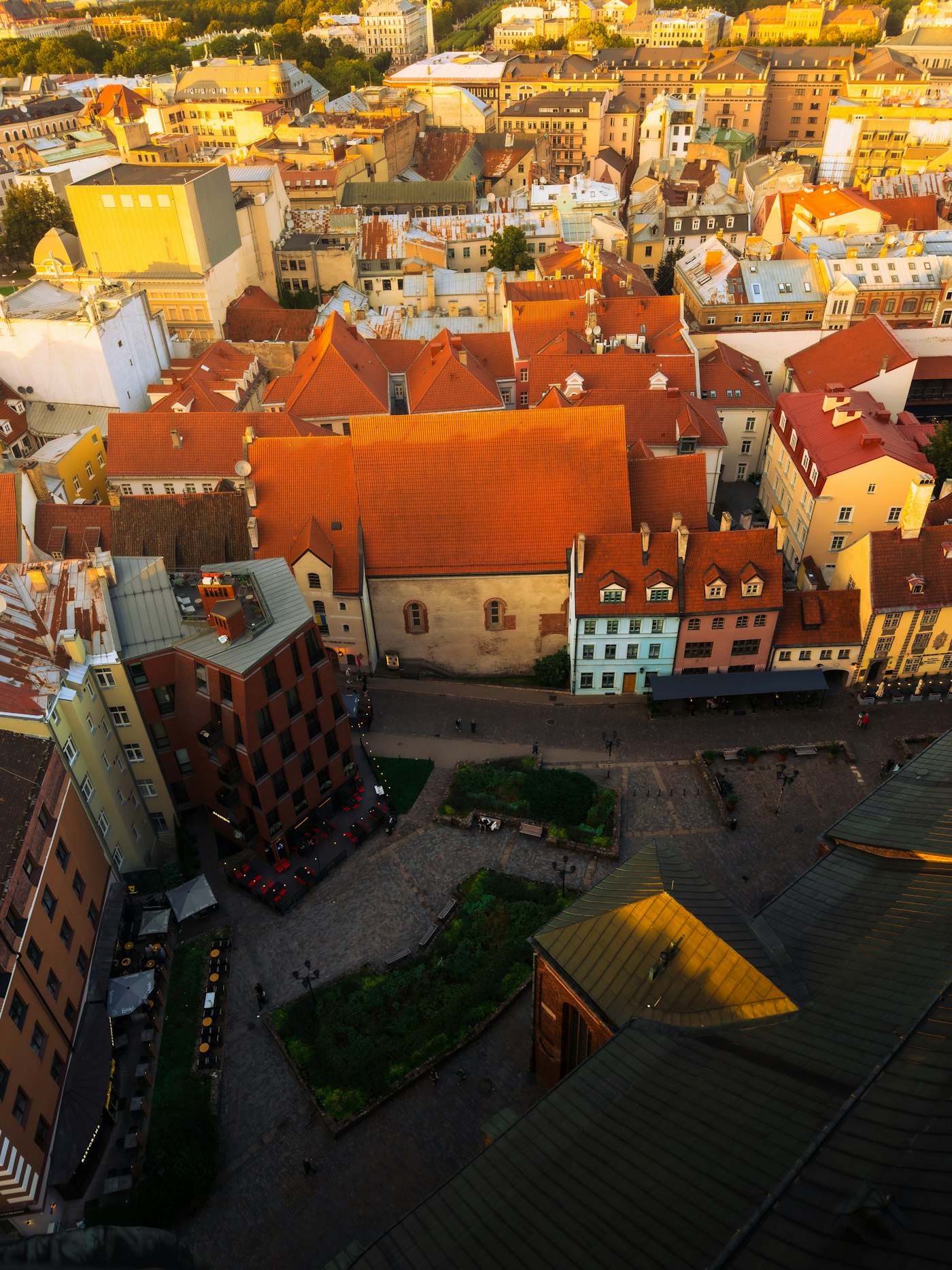 Old town, Riga
Latvia SIA versus Estonia e-Residency
The two differences that decide it.
Estonia is the usual comparison for anyone weighing a Latvian SIA, most often through the e-Residency programme. Both countries tax profit only on distribution, so the headline looks like a tie. Two differences decide it.
| Factor | Latvia SIA | Estonia OU (e-Residency) |
|---|---|---|
| Tax on reinvested profit | 0%, stable | 0%, but distribution rate rising (22/78 from 2025) |
| What the ID gives you | A real EU company plus a route to residency if wanted | A digital ID, not tax residency |
| Banking | Traditional banks plus EMIs, arranged locally | Often EMI-only, traditional accounts hard to get |
| Share capital | EUR 2,800, or EUR 1 small-capital | EUR 2,500 standard |
The point people miss: e-Residency is a convenient login, not a fiscal status. It does not change where you personally pay tax, and if you stay resident in a high-tax country your home rules still reach the profit. Estonia's distribution rate has also been climbing, while Latvia's 0/20 has held steady. For a founder who wants a genuine EU footprint, workable banking and, later, an actual residency option, the SIA usually wins on substance.
Frequently asked questions
Straight answers to what founders ask us most.
Yes. There is no residency or citizenship requirement, and a foreigner can own 100% of a Latvian SIA. The company can have one or several shareholders of any nationality, and the whole formation can be handled remotely by power of attorney.
The official register fee is around EUR 150 (about EUR 250 for expedited processing), with notary and translation typically EUR 200 to 400. On top sits the EUR 2,800 share capital, which stays in your company as working funds. The service scope depends on the founders, documents, banking route, registered address, accounting and any substance requirements. We confirm it after the first call.
The register processes applications in 1 to 3 business days on the standard track, or one day expedited. End to end, including document preparation, most setups run 2 to 5 business days to a live company, with the VAT number following in 5 to 10 days.
EUR 2,800 for the standard SIA, deposited into the company account at formation and kept as working capital afterwards. A small-capital SIA from EUR 1 is available since 2021 for a single individual shareholder below set turnover thresholds, though the EUR 2,800 form stays the sensible default for banking credibility.
No. Incorporation is fully remote thanks to the register's digital system and a power of attorney we prepare, so you sign from home. One short trip may be useful for certain bank onboarding, depending on the provider, but it is not required to form the company.
0% on profit that stays in the company, and 20% on profit you distribute as dividends, applied on a 20/80 base. For a business that reinvests heavily the effective overall rate is around 15%, and the deferral means untaxed capital keeps working until you decide to take money out.
You need a business account, and it does not have to be a traditional Latvian bank. A Revolut Business or Wise account opens remotely in a few days and covers multi-currency and card payments; many clients add a local bank such as Citadele or BluOr for a Latvian IBAN. We point you to whichever fits your activity.
Both defer corporate tax until distribution, so the choice turns on banking and status. Estonia's e-Residency is a digital ID, not tax residency, and traditional banking is harder; its distribution rate has been rising. A Latvian SIA gives a real EU company, workable banking through banks and EMIs, and an optional route to residency, which is why it usually wins for founders who want genuine substance.